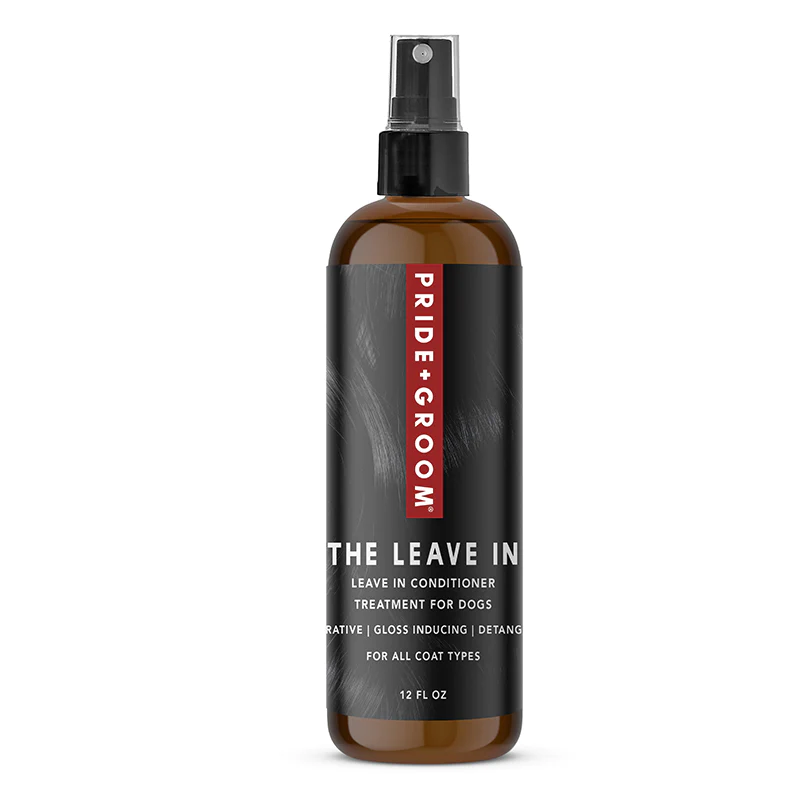
What the spray is actually doing
A leave-in conditioning or detangling spray is not a styling extra — on legs it’s a mechanical aid. It coats each hair shaft so hairs slide past one another instead of catching, kills the winter static that makes coat grab coat, and lets a comb pass through with far less force. Less force means less broken coat and less pulling on thin leg skin. What it cannot do is dissolve an existing tight mat, and it should never be used to “slip” a comb through a mat you haven’t actually broken up — that just hides the mat and lets it tighten closer to the skin.
Rinse-out conditioner (used in the bath) and leave-in spray are different tools: the rinse-out one conditions during washing, the spray is a between-baths maintenance product for damp or dry coat.
Choosing a product
- Detangling / grooming sprays are the lightest option and the right default for a quick leg touch-up.
- Leave-in conditioning sprays add moisture as well as slip — the better choice in winter, when indoor heat dries the coat and skin out and friction mats form faster on dry, brittle hair.
- Diluted rinse-out conditioner in a spray bottle is a common cost-saving route: roughly one part conditioner to eight or ten parts water is the usual home starting point. Start weaker than you think you need, shake well, and patch-test on one leg — too strong leaves a tacky residue that actually attracts dirt and clumps the coat. Always defer to the product label where it gives a dilution.
- Avoid heavily fragranced human conditioners and anything with ingredients your dog’s skin has reacted to before. If your dog has known skin issues or allergies, patch-test on a small area 24 hours ahead.
Heavy silicone-based products give great slip but can build up over repeated use and leave coat that feels coated rather than clean; rotate them out and make sure baths are actually washing product residue out.
When NOT to spray and blow dry
Never start by wetting or bathing a matted dog. Water swells the hair and shrinks and tightens tangles, and blow drying a wet mat bakes it into felt. If the leg already has mats:
1. Work on the dry coat first. Separate and pick apart mats with your fingers and a comb, using a dematting spray sparingly on the specific mat.
2. Only once the coat combs through cleanly do you bathe or mist-and-dry.
3. If a mat is tight against the skin on a leg, stop — see the tight-mat guidance in the brushing entry. Cutting or clipping is a professional job at that point.
Application: how much and where
- Fine mist, light and even. You want the coat faintly damp and slippery, not wet. Soaking the leg defeats the purpose and adds drying time in cold weather.
- Hold the bottle roughly 6–8 inches away and mist in short passes, or spray into your palm/brush first and work it in — that gives you more control on small areas and keeps product out of eyes and off the floor.
- Target the areas you’re about to work: back of the front legs, armpit crease, inside of the rear thighs and groin, hocks, and rear trousers.
- Keep it off the face and out of eyes, and don’t spray toward ears.
- Give it 30–60 seconds to sit before you start combing. Working it in immediately is less effective than letting it coat the hair first.
- Then comb through with a metal comb to distribute it evenly to the skin, not just the surface.
The blow-dry sequence
The goal of drying legs is not just “dry” — it’s straight and separated. A leg that air dries curls and clumps as it dries, and those clumps are the seed of tomorrow’s mat. Drying the hair under gentle tension while it dries is what leaves a leg that stays mat-free for days.
1. Towel dry first. Blot and squeeze — don’t rub hard, which roughs up the cuticle and encourages tangling. Get the leg from dripping to damp.
2. Mist with leave-in spray and comb through to the skin.
3. Set the dryer to low-to-medium heat and medium airflow. High heat on thin leg skin is a burn risk, and high velocity on a long coat tangles it. Keep the nozzle moving constantly and at least 6 inches off the coat; test the air on your own inner wrist where it hits the dog. Never park the nozzle on one spot.
4. Dry one leg at a time, top down. Start at the upper leg and follow the hair’s natural growth direction down the leg. Keeping the airflow moving down the leg lays the feathering straight rather than blowing it into a curl.
5. Work with your free hand. Hold each section of hair straight and slightly taut with your fingers, or run a pin brush or slicker just behind the airflow, so the hair dries stretched and flat. This is the step that does the actual mat prevention — the dryer only sets what your hand and brush have arranged.
6. Check the hidden areas separately. Armpits, the inside of the thighs, and the groin hold moisture longest and are the top spots for mats and hot spots. Dry them until the skin itself feels dry to the touch, not just until the surface looks dry.
7. Finish with a cool shot. Cool air sets the coat, tightens the look of the feathering, and — practically — it’s how you find damp spots, because cool air on still-damp coat feels cold to your hand.
8. Final comb check. Metal comb from the top of each leg to the paw, all four sides, down to the skin. If it snags anywhere, that spot is still damp or a tangle is forming. Re-mist lightly and redo that section.
Handling a dog that dislikes the dryer
- Towel dry as much as possible before the dryer comes out; a less-wet dog needs far less dryer time.
- Let the dog investigate the dryer while it’s off, then run it on low nearby before pointing it at the dog.
- Dry in short bursts with breaks and rewards rather than one long session.
- Ear protection (a fabric ear wrap or a snug hood) and a non-slip mat make a real difference to noise-sensitive dogs — but never cover the face, and never leave a wrapped dog unattended.
- If your dog is genuinely panicked by the dryer, don’t force a full blow-dry on legs. Towel dry thoroughly, comb the legs out while damp to keep the hair separated and lying straight, and re-comb once dry.
The winter routine in one line
Quick comb of all four legs after every wet walk, mist-and-dry when the legs get soaked, full line-brush plus comb twice a week, and a check under every harness or coat strap daily. The spray and the dryer make the brushing easier and the result last longer — they don’t replace brushing to the skin.